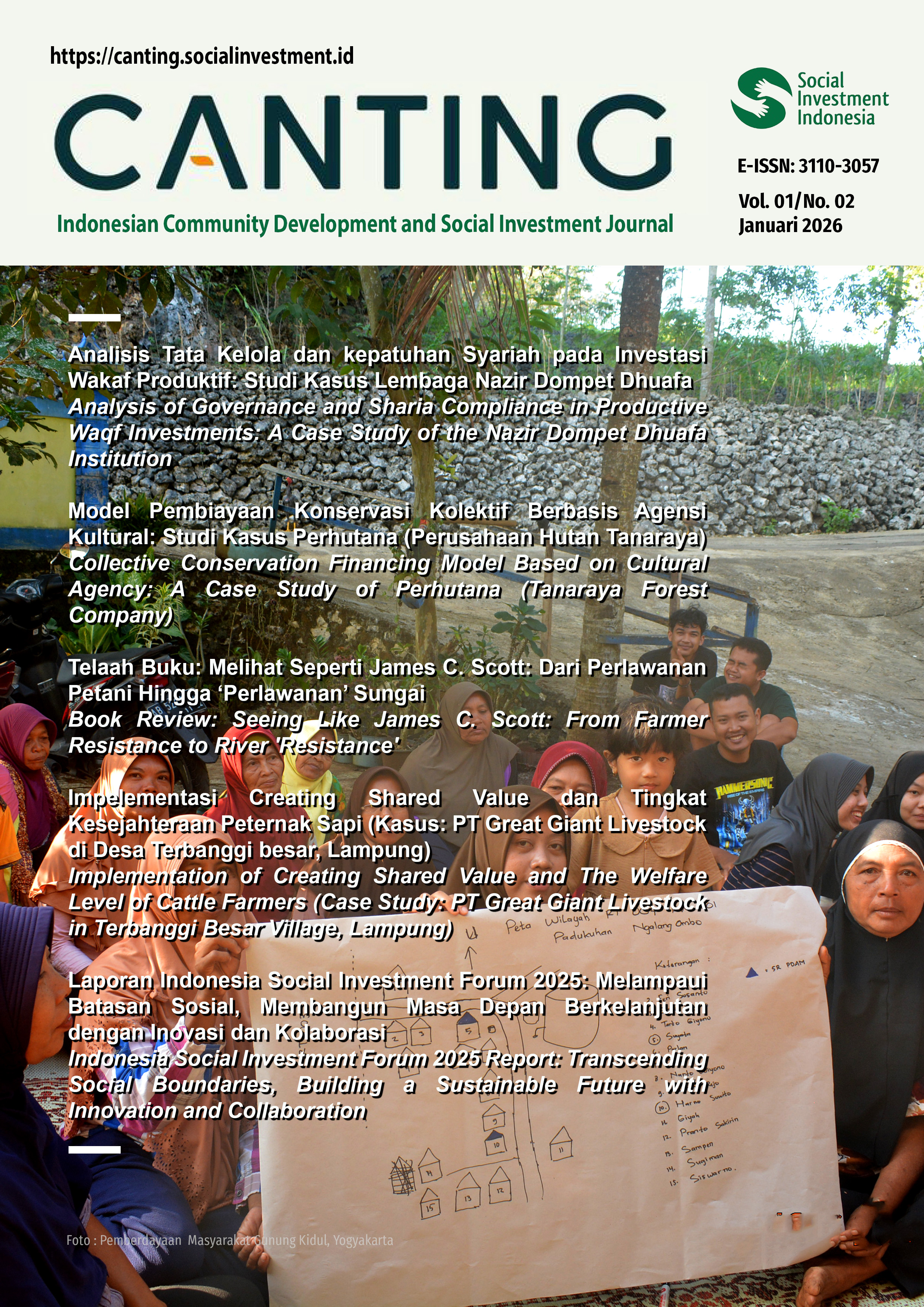
Analysis of Sharia Governance and Compliance in Productive Waqf Investments: A Case Study of the Nazir Dompet Dhuafa Institution
DOI:
https://doi.org/10.64895/hytjfc67Keywords:
Wakaf Produktif, Good Corporate Governance (GCG), Kepatuhan Syariah, Analytic Network Process (ANP), Kinerja Investasi, NazirAbstract
This study aims to analyze the fundamental causes of the low performance of productive waqf asset investments at Dompet Dhuafa, one of Indonesia's leading philanthropic institutions. The research problem centers on the significant gap between large asset potential and minimal financial returns. The methodology used is a mixed-methods approach centered on the Analytic Network Process (ANP). Key findings indicate that the low surplus (less than 1% return on commercial assets in 2017) is not solely a result of market conditions but rather a symptom of deep-rooted systemic failures in governance and compliance. The ANP model identifies four key problem clusters in order of priority: (1) inadequate human resource (nazhir) competency, (2) erosion of public trust, (3) weaknesses in internal systems and legal frameworks, and (4) inadequate oversight of sharia compliance. The main implication of this study is that sustainable and productive waqf management depends on the strict implementation of Excellent Corporate Governance (GCG) principles and the empowerment of an independent Sharia Supervisory Board.
Downloads
Downloads
Published
Issue
Section
License
Copyright (c) 2026 Imam Alfaruq, Zainal Abidin, Iqbal Iqbal (Author)

This work is licensed under a Creative Commons Attribution 4.0 International License.
This article is licensed under a Creative Commons Attribution 4.0 International License (CC BY 4.0).
You are free to share and adapt the material for any purpose, even commercially, as long as proper credit is given to the author.
<a href="https://creativecommons.org/licenses/by/4.0/" target="_blank">
<img src="https://licensebuttons.net/l/by/4.0/88x31.png" alt="CC BY 4.0"/>
</a>