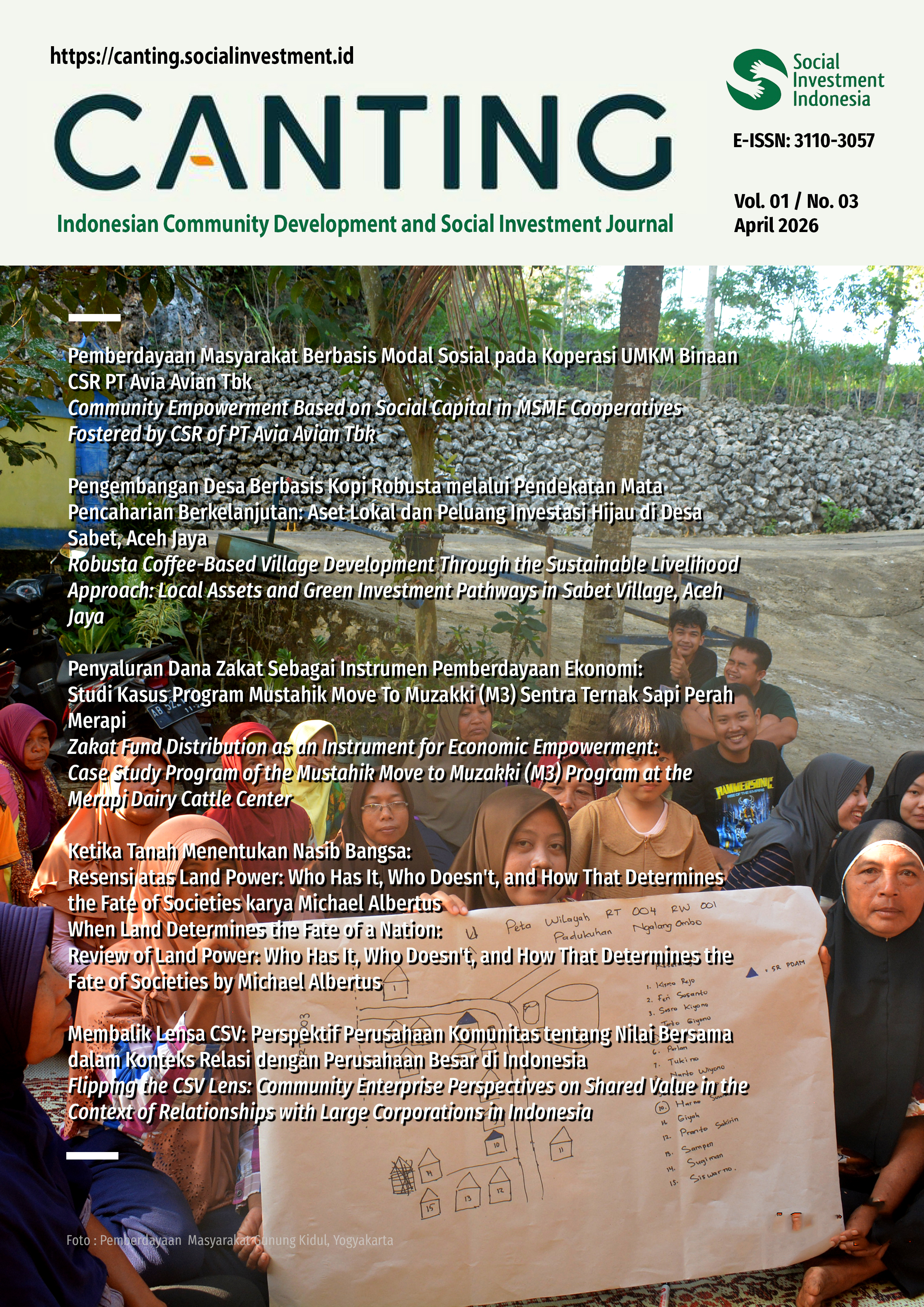
Zakat Fund Distribution as an Instrument for Economic Empowerment:Case Study Program of the Mustahik Move to Muzakki (M3) Program at the Merapi Dairy Cattle Center
DOI:
https://doi.org/10.64895/r0nrd023Keywords:
Productive Zakat, Local Institutions, Merapi, Mustahik, Community Empowerment, Dairy Cattle, SROIAbstract
The Mustahik Move to Muzakki (M3) Programme is a productive-zakat-based economic empowerment initiative implemented by Karya Masyarakat Mandiri – Dompet Dhuafa in Desa Umbulharjo, Cangkringan District, Sleman Regency, Yogyakarta Special Region, over 26 months (November 2015–December 2017). The programme targeted 45 mustahik households affected by the Merapi volcanic eruption, providing productive capital in the form of 71 pregnant dairy heifers, intensive mentoring, and local institutional strengthening. This article examines the programme's effectiveness in increasing beneficiary income relative to the Regency Minimum Wage (UMK) and analyses the three-stage empowerment model (pioneering–strengthening–independence) as a socio-economic transformation framework. Using an evaluative case study approach with longitudinal analysis over 26 monthly periods, findings show that average partner income increased from IDR 895,195/month to IDR 3,103,997/month—equivalent to 2.59× the 2015 UMK, exceeding the 1.5× UMK target. The estimated Social Return on Investment (SROI) ratio is 2.09:1. This study affirms that community-based productive zakat with layered mentoring can accelerate the mustahik-to-muzakki transition, though post-programme sustainability requires strengthened managerial capacity within local institutions.
Downloads
Downloads
Published
Issue
Section
License
Copyright (c) 2026 Zainal Abidin, Casdimin, Iqbal, Nurtania Sudarmi (Author)

This work is licensed under a Creative Commons Attribution 4.0 International License.
This article is licensed under a Creative Commons Attribution 4.0 International License (CC BY 4.0).
You are free to share and adapt the material for any purpose, even commercially, as long as proper credit is given to the author.
<a href="https://creativecommons.org/licenses/by/4.0/" target="_blank">
<img src="https://licensebuttons.net/l/by/4.0/88x31.png" alt="CC BY 4.0"/>
</a>